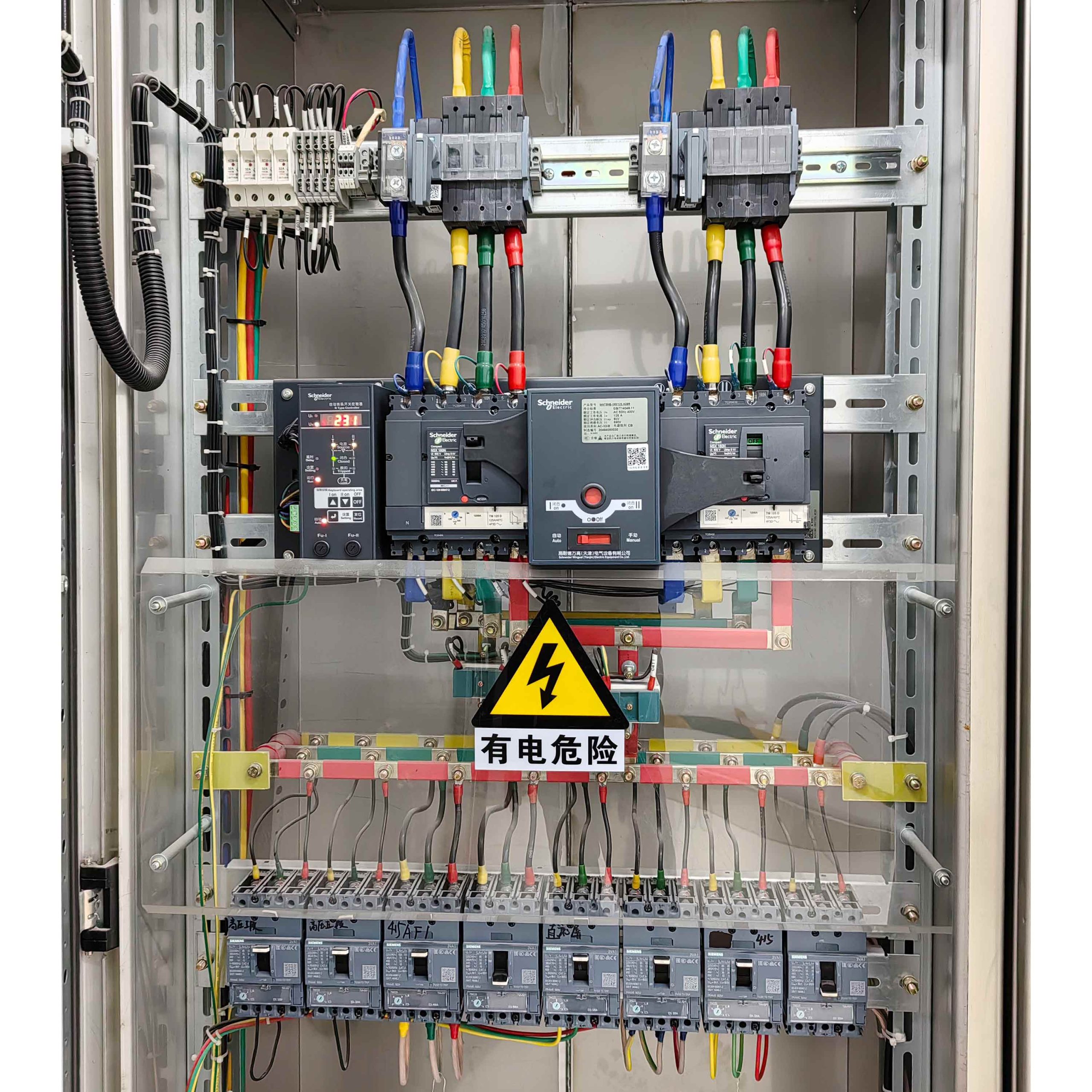
What is low voltage switchgear? It is a factory-built assembly of air circuit breakers (ACBs), moulded-case circuit breakers (MCCBs), contactors, busbars, meters and protection devices that distributes and protects electrical power at up to 1,000 V AC (1,500 V DC). It sits between the transformer and the loads — motors, lighting, HVAC and process equipment — and disconnects overloads and short circuits before they damage cables or equipment.
Almost every factory, commercial building, hospital, data centre and water plant depends on it. This guide covers its components, common types, the standards that apply, and how to specify it correctly.
Key takeaways
- Low voltage means up to 1,000 V AC or 1,500 V DC under IEC terminology.
- Core parts: incoming ACB, outgoing MCCBs or fuses, busbars, metering, and often motor starters or VFDs.
- Common types: power distribution centres (PCC), motor control centres (MCC), withdrawable and fixed-type cabinets such as GCS, MNS and GGD.
- Assemblies are designed and verified to IEC 61439-1 and IEC 61439-2.
- Specify rated current, short-circuit withstand, form of separation, IP rating and incoming/outgoing arrangement.
What Is Low Voltage Switchgear Made Of?
| Component | Function |
|---|---|
| Air circuit breaker (ACB) | Main incomer or large feeder breaker, typically 630–6300 A, often withdrawable |
| Moulded-case circuit breaker (MCCB) | Protects outgoing feeders, typically 16–1600 A |
| Busbar system | Distributes current between sections; rated for both current and short-circuit withstand |
| Contactors and motor starters | Switch motors on and off; DOL, star-delta or soft starters |
| Variable frequency drives | Control motor speed for pumps, fans and conveyors |
| Metering and power monitoring | Measure current, voltage, energy and power quality |
| Surge protection devices | Protect connected equipment from transient overvoltages |
| Automatic transfer switch (ATS) | Switches between mains and generator supply |
Common Types
- Power control centre (PCC) – the main distribution board directly after the transformer, with large ACB incomers and feeder breakers.
- Motor control centre (MCC) – groups the starters, VFDs and protection for many motors in one line-up, often with withdrawable drawers.
- Withdrawable cabinets (e.g. GCS, MNS) – functional units on drawers that can be replaced quickly without shutting down the whole board.
- Fixed-type cabinets (e.g. GGD) – simpler and lower cost; components are fixed, so maintenance needs a longer outage.
- Final distribution boards – smaller boards that feed lighting and socket circuits.
Standards and Forms of Separation
Low voltage assemblies are designed and verified to IEC 61439-1 (general rules) and IEC 61439-2 (power switchgear and controlgear assemblies). The standard requires design verification of temperature rise, short-circuit withstand, dielectric properties and clearances, plus routine verification of every assembly before it leaves the factory.
IEC 61439 also defines forms of internal separation, from Form 1 (no internal separation) to Form 4 (busbars, functional units and terminals all separated). Higher forms allow work on one circuit while others stay live, at a higher cost and size.
How to Specify It
- Rated current of the incomer and main busbar, based on the transformer size.
- Short-circuit rating (Icw / Ipk) that matches the prospective fault current at the installation point.
- Number and rating of outgoing feeders, plus spare ways for future loads.
- Form of separation and whether functional units should be fixed, plug-in or withdrawable.
- Degree of protection (IP rating) and ambient conditions such as temperature, altitude and humidity.
- Cable entry (top or bottom), metering, communication protocol and any automatic transfer scheme.
A Typical Arrangement
In a typical industrial plant, power arrives at medium voltage and is stepped down by a transformer, for example 10 kV to 400 V. From there:
- The transformer feeds the main incomer ACB of the power control centre through busbar trunking or cables.
- The PCC distributes power to large feeders: MCCs, HVAC plant, compressors and sub-distribution boards.
- Each MCC controls a group of motors with starters, soft starters or VFDs, each with its own protection.
- Final distribution boards feed lighting, sockets and small loads.
- A generator and automatic transfer switch can supply essential loads if the utility supply fails.
Testing and Maintenance
- Routine verification at the factory: wiring checks, dielectric test, insulation resistance, mechanical operation and functional tests of control circuits.
- Site checks before energising: torque on busbar and cable connections, insulation resistance, breaker trip settings and phase rotation.
- Annual maintenance: thermographic scan under load, cleaning, checking terminations, exercising breakers and testing protection settings.
- Records: keep as-built drawings, test reports and breaker settings up to date after every modification.
Common Specification Mistakes
- Choosing a board rated for the normal current but not for the prospective short-circuit current at the site.
- Leaving no spare ways or space for future feeders, so later expansions need a new board.
- Ignoring heat from VFDs and other electronics, which leads to derating or nuisance trips in hot climates.
- Specifying fixed-type units for critical loads where withdrawable units would cut repair time.
- Not coordinating breaker settings, so a fault on one circuit trips the main incomer and blacks out the plant.
Where It Is Used
- Factories and process plants – main distribution and motor control
- Commercial and public buildings – main boards, HVAC and lift supplies
- Water and wastewater plants – pump motor control and VFD panels
- Data centres and hospitals – critical power with generator and UPS changeover
How to Choose a Supplier
The quality of a low voltage board depends as much on the builder as on the brand of breakers inside it. When comparing suppliers, check that they can:
- Show design verification to IEC 61439-2 for the busbar system and enclosure you are buying, not just for the components.
- Provide routine verification reports for every assembly, with test results for insulation and functional checks.
- Use genuine, traceable breakers and drives from the brands named in your specification.
- Supply complete documentation: single-line diagram, general arrangement, wiring diagrams, bill of materials and settings list.
- Support installation, commissioning and spare parts in your region.
Danli builds low-voltage switchgear cabinets, MCCs and VFD cabinets for industrial and commercial projects. Request a quote with your single-line diagram and load list.
Frequently Asked Questions
Under IEC standards, low voltage is up to 1,000 V AC or 1,500 V DC. Typical systems are 400/230 V, 690 V or 480 V depending on the country.
An ACB is a large, often withdrawable breaker used as the main incomer or for big feeders. An MCCB is smaller and protects outgoing feeders and individual loads.
An MCC is one type of low voltage switchgear dedicated to controlling and protecting motors. A PCC or main board distributes power to feeders, including the MCC.
With regular maintenance, a well-built assembly typically lasts 20–30 years, although breakers and electronic devices may need replacement earlier.