
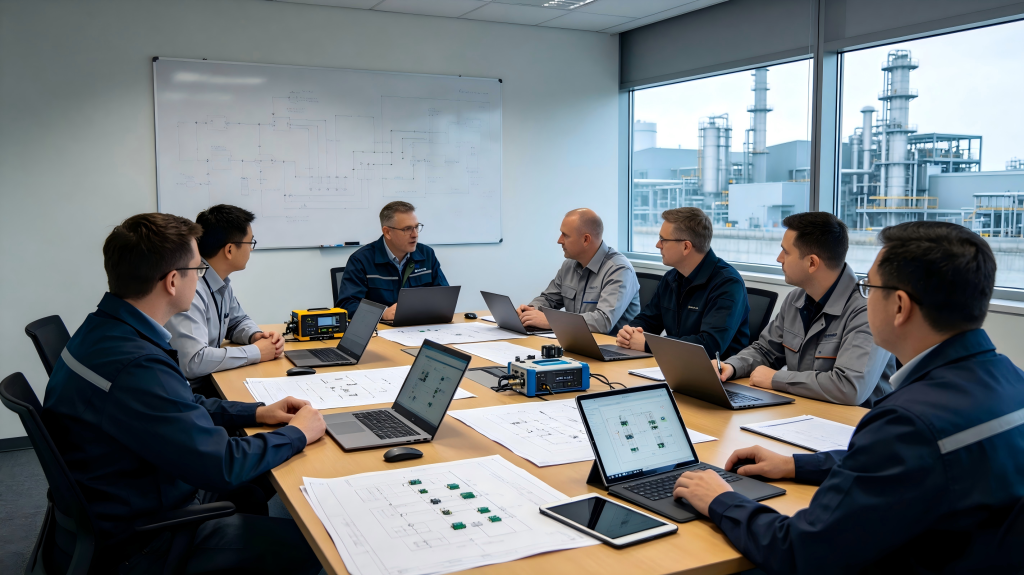
Danli’s cabinet design service turns your process and electrical requirements into complete, buildable control and distribution panels. Our engineers prepare schematics, layouts, component selections and documentation that meet the applicable standards, are easy to manufacture and maintain, and leave room for future expansion.
| Deliverable | What it includes |
|---|---|
| Electrical schematics | Power, control and I/O circuits with device tags and wire numbers |
| General arrangement | Enclosure size, door layout, mounting plate layout, cable entry |
| Component selection | Breakers, contactors, PLCs, drives, power supplies and terminals from specified brands |
| Thermal design | Heat-loss calculation and selection of fans, heat exchangers or air conditioning |
| Bill of materials | Complete parts list with manufacturer part numbers |
| Terminal and cable schedules | Field connection details for installers |
Because our design and production teams work together, drawings are checked for manufacturability before release. After your approval, the same documents are used to build, wire and test the cabinets in our factory, and the as-built set is updated after the factory acceptance test. See how this connects with system integration, software development and our electrical control cabinets.
Clear, approved drawings at this stage are the single best way to avoid rework in the workshop and on site, and they remain the reference for maintenance throughout the life of the equipment.
Heat is one of the main causes of early failure in control equipment. For every enclosure we estimate the heat produced by drives, power supplies and other devices and compare it with the heat the enclosure can lose at the site’s maximum ambient temperature. If the margin is too small, we specify filtered fans, air-to-air heat exchangers or air conditioners. On the safety side, we include main isolators with door interlocks, finger-safe terminals, protective earthing of doors and plates, and clear warning labels, so the panel is safe to operate and maintain. Short-circuit ratings of busbars and protective devices are checked against the prospective fault current at the point of installation.
An I/O list or equipment list, single-line diagram or load list, supply voltage, preferred component brands, applicable standards and site conditions.
We produce drawings in professional electrical CAD tools and can deliver PDF and native files according to your requirements.
Yes. We can follow client drawing templates, tag-naming rules, component lists and colour codes.
Simple panels can be designed in a few days; large systems with many cabinets usually take two to four weeks, including your review.
From a single control cabinet to full plant-wide automation.

Custom power distribution & automation control systems — high-voltage to intelligent PLC/DCS.
Zhejiang Danli Intelligent Control Technology Co., Ltd.
Est. 2013 · Hangzhou, China · National High-Tech Enterprise
© 2026 Zhejiang Danli Intelligent Control Technology Co., Ltd. All rights reserved.