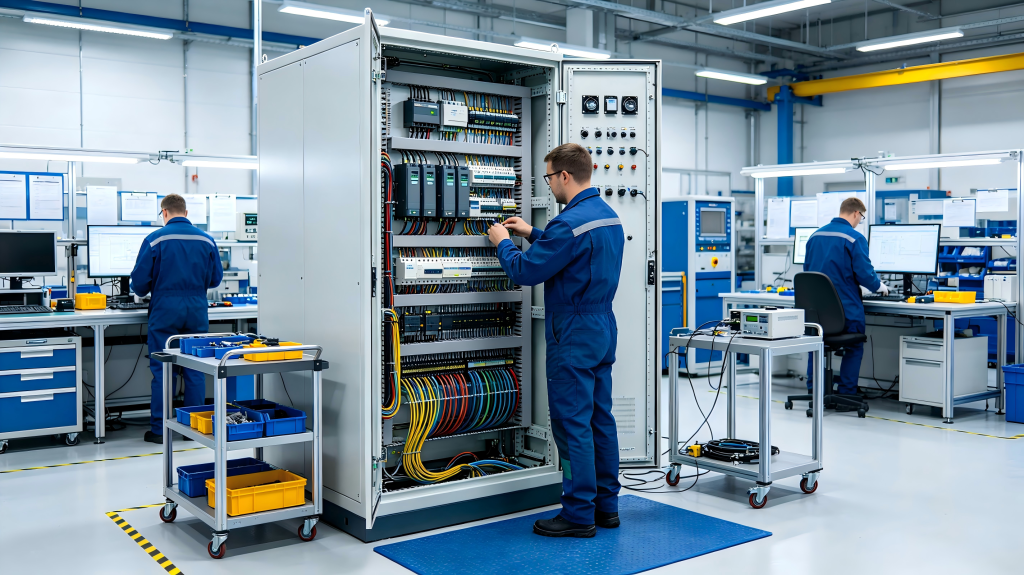
Danli’s system integration service brings PLCs, drives, HMIs, SCADA, switchgear and field devices together into one tested, working control system. Instead of managing several suppliers and fixing interface problems on site, you receive integrated cabinets and software that have already been tested together in our factory.
| Layer | Typical equipment |
|---|---|
| Field | Sensors, transmitters, analysers, valves, motors |
| Power and motor control | Switchgear, MCCs, soft starters, VFDs |
| Control | PLCs and DCS controllers from major brands, remote I/O, safety controllers |
| Operator interface | HMI panels, SCADA servers and workstations |
| Communication | PROFINET, EtherNet/IP, Modbus TCP/RTU, OPC UA, IEC 61850 |
Related: PLC and DCS cabinets, software development and project commissioning.
Our integration work covers water and wastewater plants with multiple remote stations, production lines that combine machine PLCs with a line controller and MES, power distribution systems that report breaker and energy data to SCADA, and process units where package skids must work with a central DCS. In each case the goal is the same: one system that operators can understand and maintenance teams can support.
Every integrated system is delivered with a network architecture drawing, a complete I/O and communication list, cabinet drawings, PLC and HMI program backups, a control narrative, FAT and SAT records, and user manuals for operators and maintenance staff.
Connected control systems need to be protected. We separate control networks from office networks, use managed switches and firewalls where required, disable unused ports and services, and set up secure, controlled remote access for support so that engineers can help diagnose problems without exposing the plant to unnecessary risk. User accounts and passwords for PLCs, HMIs and SCADA are documented and handed over at the end of the project so the owner stays in control.
We integrate the major international platforms, including Siemens and Allen-Bradley, and others according to your site standard.
Yes. We connect package PLCs and smart devices over standard protocols such as Modbus TCP, PROFINET or OPC UA and test the interfaces in advance where possible.
Yes. A factory acceptance test checks I/O, sequences, alarms and communication with simulated field signals before delivery.
Yes. We review the existing system, define interfaces and plan the cut-over to keep downtime to a minimum.
From a single control cabinet to full plant-wide automation.