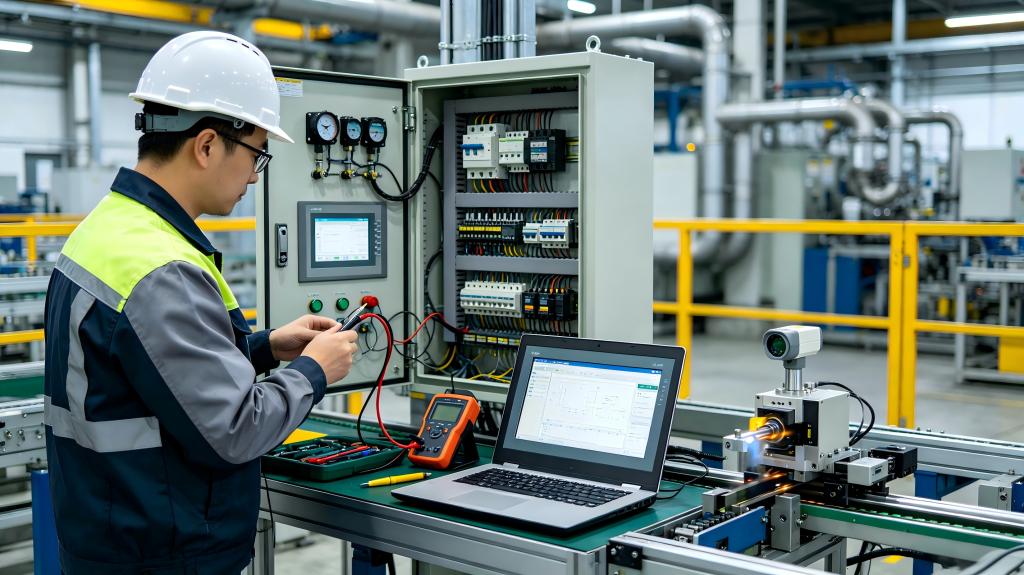
Danli’s commissioning services take switchgear, control cabinets and automation systems from installation to safe, reliable operation. Our engineers check every connection, test protection and control functions, start equipment step by step and train your team, so the plant is handed over working as designed and with complete records.
| Stage | Typical activities |
|---|---|
| Pre-commissioning | Visual inspection, torque checks, insulation resistance tests, continuity and polarity checks, CT/VT ratio checks |
| Protection testing | Secondary injection of relays, trip and interlock tests, breaker timing |
| Cold commissioning | I/O loop checks from field device to HMI, valve and motor direction checks without process load |
| Energisation | Controlled switching-on of incoming supplies and feeders following an agreed sequence |
| Hot commissioning | Running equipment with process load, tuning control loops, proving sequences and alarms |
| Handover | Site acceptance test, punch-list closure, as-built drawings, training |
Commissioning is when equipment is energised for the first time, so it is one of the highest-risk stages of a project. We work to a written method statement and the site’s permit-to-work system, use lock-out and tag-out for every isolation, and agree energisation steps with the client and site authority in advance. Only trained and authorised engineers carry out switching and testing on live equipment.
Related services: solution evaluation, system integration and after-sales support.
Most problems that appear in the first months of operation — nuisance trips, motors running in the wrong direction, unstable control loops, alarms that operators ignore — can be traced back to steps skipped during commissioning. A structured approach finds these issues before production starts, protects expensive equipment during first energisation and gives the owner a documented baseline for future maintenance. It also shortens the time from mechanical completion to full output, which is usually where the real cost of a delay lies.
Commissioning goes faster when the site is ready. Before our engineers arrive, we agree a checklist with you: installation and cable termination complete, earthing finished and tested, temporary or permanent power available, field instruments installed and calibrated, process media and loads available for hot tests, and the right client staff available for witnessing and training. Clear communication on these points avoids idle time and repeat visits.
For projects outside China we combine remote preparation with on-site engineers. Test procedures, I/O lists and energisation sequences are agreed before travel, programs are pre-tested in our factory, and our engineers can work alongside your local electrical contractor. After handover, remote support helps with tuning, minor changes and troubleshooting during the first months of operation.
A factory acceptance test (FAT) checks equipment in the factory before shipment. A site acceptance test (SAT) proves the installed system works with real field devices and process conditions.
Yes. Many checks and software changes can be supported remotely with secure access and video calls, with engineers on site for energisation and critical tests.
Test records, protection settings, I/O check sheets, punch lists, as-built drawings, program backups and operation and maintenance manuals.
Yes. Training covers normal operation, alarms, safe isolation and basic troubleshooting, adapted to your operators and maintenance staff.
From a single control cabinet to full plant-wide automation.
Custom power distribution & automation control systems — high-voltage to intelligent PLC/DCS.
Zhejiang Danli Intelligent Control Technology Co., Ltd.
Est. 2013 · Hangzhou, China · National High-Tech Enterprise
© 2026 Zhejiang Danli Intelligent Control Technology Co., Ltd. All rights reserved.